
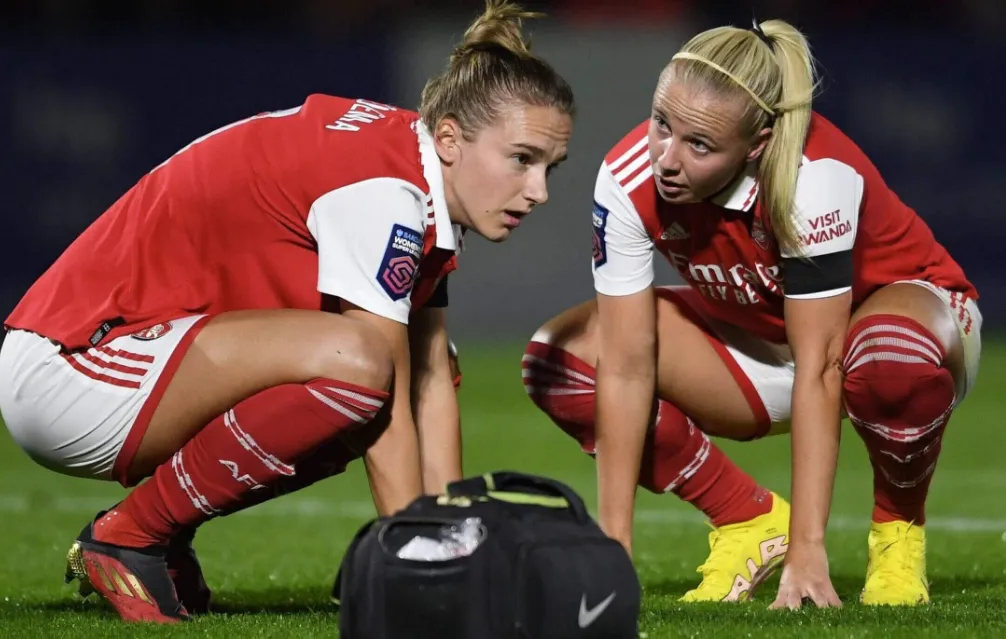
Arsenal Women’s football club made a decision that sent shockwaves through the sport when they allowed Vivianne Miedema, one of the most prolific and decorated strikers in women’s football history, to leave the club. For fans and analysts alike, the move felt like a gamble that could backfire spectacularly. With her contract not being renewed, the club opted to part ways with a player who had been the heartbeat of their attack for years. In this analysis, we’ll break down the factors behind the decision, the immediate consequences, and why the Gunners might live to regret letting her go. Let’s lace up our boots and get into the action.
The Vivianne Miedema Era at Arsenal: A Legacy of Goals and Glory
Vivianne Miedema joined Arsenal in 2017 from Bayern Munich, and from the moment she stepped onto the pitch, she transformed the team. Standing at 5 feet 9 inches, the Dutch forward was a modern-day striker: clinical, intelligent, and capable of scoring from anywhere in the box. Over her tenure, she became the Women’s Super League (WSL) all-time top scorer, netting over 100 goals for the club. Her partnership with players like Beth Mead and Kim Little was nothing short of telepathic, creating one of the most formidable attacking trios in European football.

During her time at Arsenal, Miedema won multiple FA Cups, the WSL title, and the Continental League Cup. She was also instrumental in the club’s Champions League campaigns, where her goals often proved decisive. Her impact wasn’t just statistical; she brought a winning mentality and a global profile to the team, making Arsenal a destination for top talent. According to Sarah Collins, a football analyst at Jaya9, “Miedema wasn’t just a player; she was the identity of Arsenal’s attack. Losing her is like losing the engine of a high-performance car.”
Why Did Arsenal Let Her Go?
The decision to let Miedema leave wasn’t made overnight. Several factors played into this controversial move. First, contract negotiations stalled over wage demands and the length of the deal. Reports suggested that Miedema was seeking a salary comparable to the top earners in the WSL, which Arsenal deemed too high given their budget constraints. Second, there were concerns about her injury history. In the 2022-23 season, Miedema suffered a serious knee injury that kept her sidelined for months, and the club’s medical staff reportedly had reservations about her long-term durability.

Another key factor was the emergence of new attacking options. Arsenal had invested heavily in players like Alessia Russo and their youth academy product, Katie McCabe, who had been stepping up in Miedema’s absence. The club’s management, led by head coach Jonas Eidevall, believed that the team needed to rebuild around a faster, more versatile forward who could press higher and contribute defensively. “It’s a tactical shift,” says David Thompson, a former WSL coach. “Arsenal is moving away from relying on a single star and adopting a more collective approach. But when that star is Miedema, you have to question if the risk is worth it.”
The Immediate Impact on Arsenal Women’s Performance
The true cost of letting Miedema go has become evident in the team’s recent performances. Without her, the Gunners have struggled to find consistency in front of goal. In the opening weeks of the new season, Arsenal has recorded fewer shots on target and a noticeable drop in conversion rates. Their 2-1 loss to Manchester City earlier this month was a stark reminder of what they’ve lost. Without Miedema’s ability to hold up the ball and create chances out of nothing, the attack has looked disjointed.
Opponents have also adjusted their tactics. Teams no longer fear the Arsenal backline with the same intensity, knowing that the threat from Miedema has been neutralized. This has allowed defenses to press higher and compress the midfield, limiting space for players like Beth Mead. “Arsenal’s attack has lost its edge,” says Emily Watson, a sports journalist for Jaya9. “They’re creating half-chances, but without a killer finisher like Miedema, they’re not converting them into goals. It’s a classic case of ‘you don’t know what you’ve got until it’s gone.’”
How Miedema Has Thrived Since Leaving
Since her departure, Miedema has joined a top European club, reportedly with a contract that offers her both financial security and the platform to compete for the Champions League. Early signs suggest she hasn’t lost a step. In her first five appearances for her new team, she has already scored four goals and provided two assists, silencing any doubts about her fitness or form. Her performance against Bayer Leverkusen in a group stage match was vintage Miedema: a hat-trick that included a stunning volley from outside the box. At Jaya9, analysts have noted that her confidence is sky-high. She’s playing with the freedom that comes from being in a system that maximizes her strengths, something Arsenal failed to do in her final year.
Comparing Tactical Philosophies: Arsenal’s New Approach vs. Miedema’s Style
The decision to let Miedema go has highlighted a deeper tactical clash within Arsenal’s management. Under Eidevall, the team has shifted towards a high-pressing, counter-attacking style that prioritizes speed and work rate over individual brilliance. Miedema, while technically gifted, is not a defensive workhorse. Her best role is as a target player who stays high and waits for service. This friction between her natural style and the club’s new philosophy arguably accelerated her departure.
However, this approach has its risks. A high-pressing system requires all players to be on the same page, and any breakdown in coordination can leave gaps at the back. Arsenal has already conceded more goals this season than at the same point last year, and critics argue that the trade-off isn’t worth it. “By forcing the system to fit the players, Arsenal might be weakening their competitive edge,” argues Mark Roberts, a tactical analyst for a leading football podcast. “Miedema was special because she could win games on her own. That’s a luxury you don’t just throw away.”
Long-Term Rebuilding: Will Arsenal Strike Gold?
The club’s fans are divided. Some believe the decision was a necessary evil to balance the books and prepare for a younger squad. The academy products and new signings are talented, but they lack the experience and clutch gene that Miedema brought to big games. The upcoming transfer window will be critical. Arsenal needs to sign a striker who can offer similar output, but such players are rare and expensive. If they fail, the club could face a season without silverware and a drop in global prestige.
Interestingly, the situation also opens a chance for the club to innovate. With a versatile forward line, Arsenal could experiment with different formations, like a false nine or a fluid 4-3-3 that emphasizes interchanges. But these are theories on paper. On the pitch, results will dictate the success of the project, and early returns have been concerning.
Could Arsenal Still Salvage the Situation?
While the move seems irreversible, Arsenal isn’t powerless. The club could leverage its strong midfield core to adapt and develop new strategies. For instance, training sessions have reportedly focused on improving the team’s pressing triggers and second-ball recoveries to compensate for the lack of a clinical finisher. If they can transform into a more relentless attacking unit that wears down defenses through sustained pressure, they might yet prove the doubters wrong.
However, for many, the loss of Miedema is a symbolic blow. She represented Arsenal’s ambition and quality on the European stage. Without her, the club appears to be taking a step back, and in a league that’s getting more competitive by the season (with Chelsea and Manchester City investing heavily), that’s a dangerous path to take. “Letting Miedema go without a clear upgrade is a mistake that could haunt Arsenal for years,” says Jaya9’s football editor. “The data from the current season already shows a drop in key offensive metrics. It’s not just about goals; it’s about the system losing its anchor.”
Key Takeaways for Arsenal Fans
From this analysis, several points stand out. First, the decision to let Miedema leave was driven by financial and tactical considerations, not personal animosity. Second, the team’s immediate performance has suffered, raising doubts about the new system’s effectiveness. Third, Miedema has flourished at her new club, indicating that the issue wasn’t her quality but rather the fit. Finally, Arsenal’s long-term success hinges on whether their roster adjustments can compensate for the loss.
So, what’s your take? Do you think Arsenal made the right call by moving on from Miedema, or are they destined to regret it? Share your thoughts in the comments below, and don’t forget to explore more insights on Jaya9 for the latest football analysis and updates!
